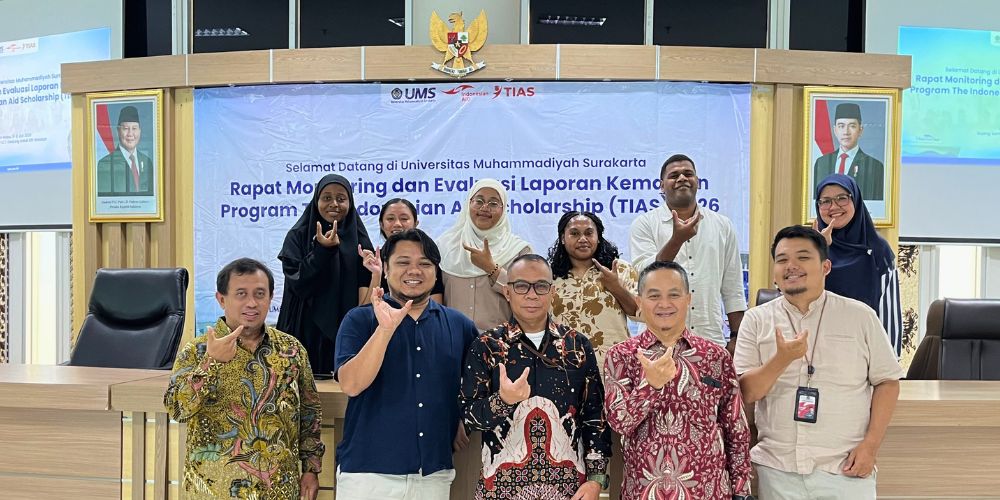
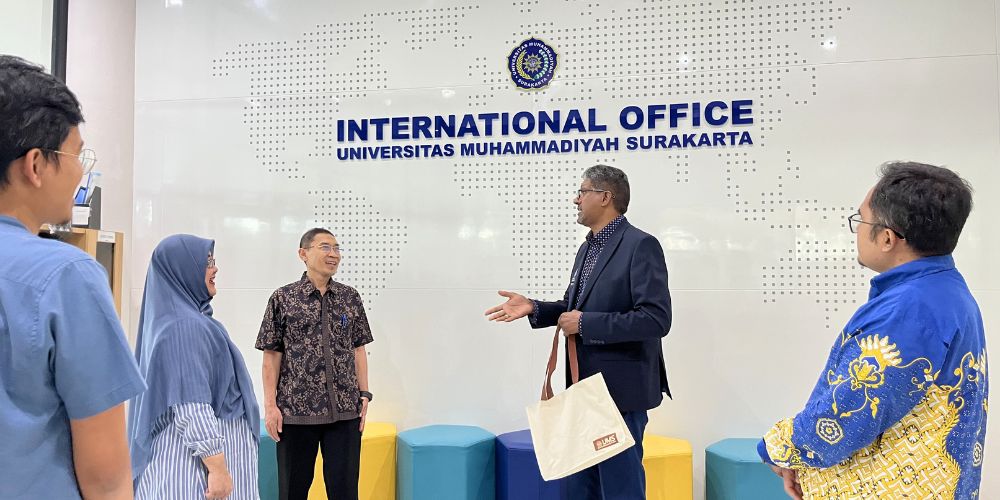
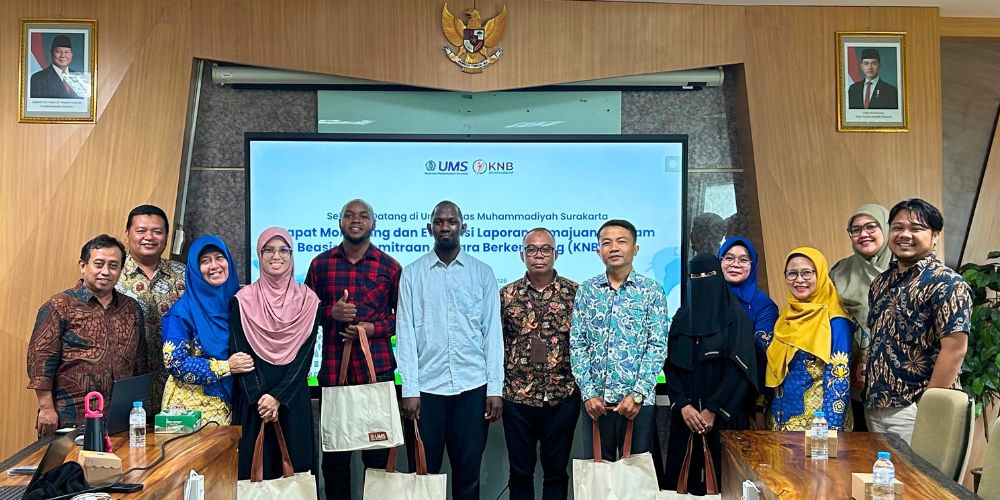
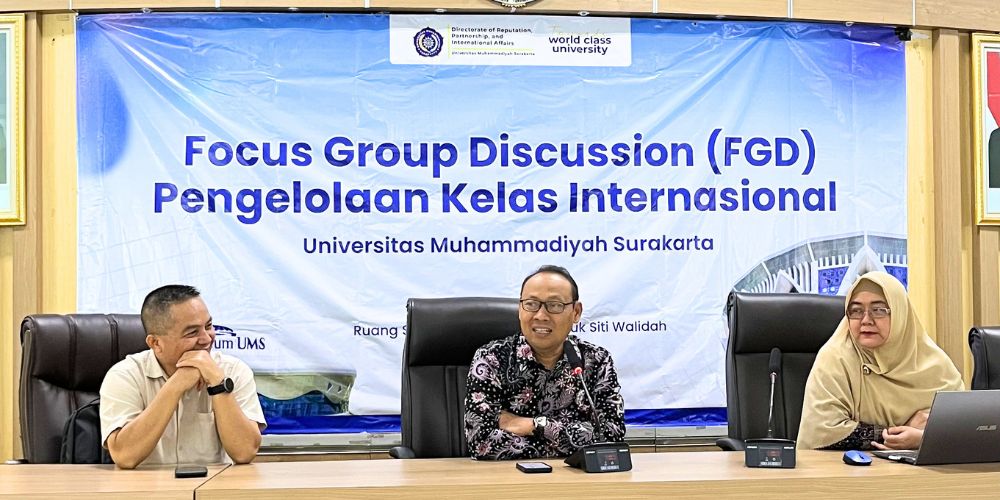
Surakarta, July 14, 2025 — Universitas Muhammadiyah Surakarta (UMS) welcomed a delegation from Universitas Wahid Hasyim (UNWAHAS) on Monday, July 14, 2025, for a benchmarking visit focused on the enhancement of academic quality and the development of international-class programs. The visit took place at the Office of Collaboration and International Affairs (BKUI) Meeting Room, 7th Floor, Siti Walidah Main Building, Universitas Muhammadiyah Surakarta.
The event began with a welcoming speech by Prof. Supriyono, S.T., M.T., Ph.D., Vice Rector V of UMS, who also provided an overview of UMS’s internationalization strategies and institutional achievements. He introduced the structure and vision behind UMS’s international class program, highlighting its role in promoting global competence and international exposure among students.
In response, Dr. Nur Cholid, M.Ag., M.Pd., Vice Rector I of UNWAHAS, expressed appreciation for the opportunity to visit UMS and emphasized that the benchmarking was aimed at strengthening institutional ties between private universities while learning from UMS’s experience in managing international classes. “We hope to open our own international class program and are here to learn how UMS prepares and runs such a program, particularly in attracting foreign students,” he stated.
During the main session, Prof. Supriyono explained that international classes at UMS are essentially regular classes delivered in English and attended by both local and international students. The presence of international students, he said, helps create a global atmosphere in the classroom, while also encouraging UMS students to participate in outbound mobility and double degree programs. “The international class also opens access to outbound mobility, double degree programs, and other forms of international exposure,” he explained.
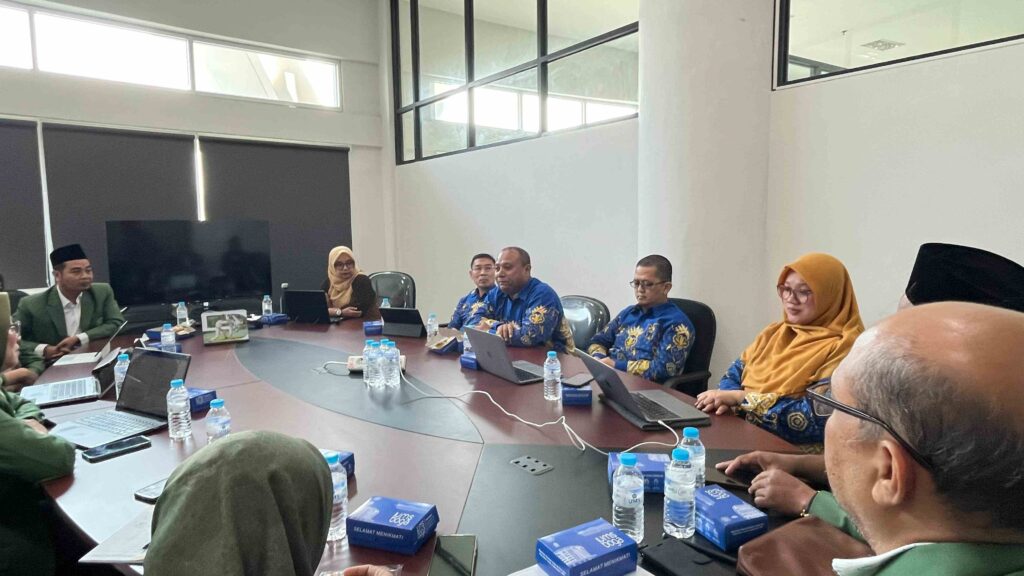
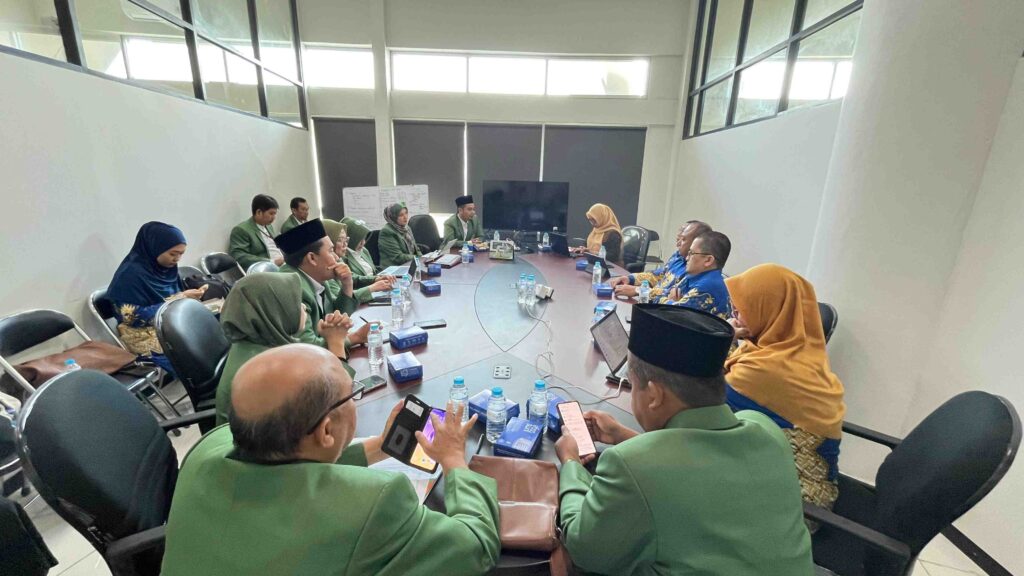
Also present was Andy Bawono, Director of the Office of Collaboration and International Affairs, who reiterated the strategic importance of international classes in the context of global engagement. “International classes must be viewed not just as income-generating programs but as core components of internationalization. They should stand as flagship programs in our academic ecosystem,” he emphasized.
A discussion and Q&A session followed, where the UNWAHAS delegation raised a variety of questions, including scholarship funding, curriculum design, international credit transfer, quality assurance, and faculty readiness. UMS explained its scholarship schemes under the IPS program, which include fully funded, partial, and self-funded options.
On the operational side, UMS clarified that each international class is managed at the study program level in coordination with BKUI. There is no distinct curriculum for international classes, students follow the same academic content as regular classes, but in English. International classes are taught by lecturers, most of whom are graduates of foreign universities and have the language proficiency to teach in English. UMS also noted that its international class facilities are housed in a dedicated section of the Siti Walidah Building.
The students enrolled in international classes at UMS are strongly encouraged to participate in outbound mobility programs as part of their academic journey. These programs are designed to provide students with valuable “international exposure”, broaden their global perspective, and enhance their intercultural competence through real-world learning experiences abroad. For international class students, participation in double degree programs is encouraged but not mandatory.
Quality assurance of international classes, according to UMS’s Office for Quality Assurance (LJM), is integrated into the university’s broader internal quality system. Monitoring is conducted through specific instruments tailored for international programs, while accreditation remains aligned with regular programs.
The discussion also touched on services for international students, including the implementation of a Buddy Program and the university’s Bahasa Indonesia for Foreign Speakers (BIPA) initiative. UNWAHAS showed particular interest in UMS’s hospitality system and how it supports international student adaptation.
The event concluded with a room tour of the international class facilities and a group photo session. UNWAHAS expressed hope that this benchmarking visit would serve as a foundation for future partnerships in international education and institutional development.