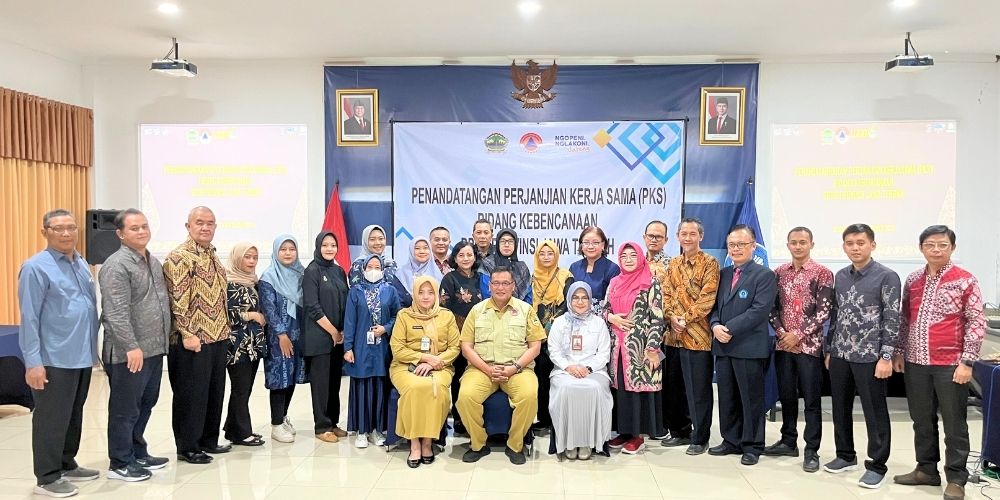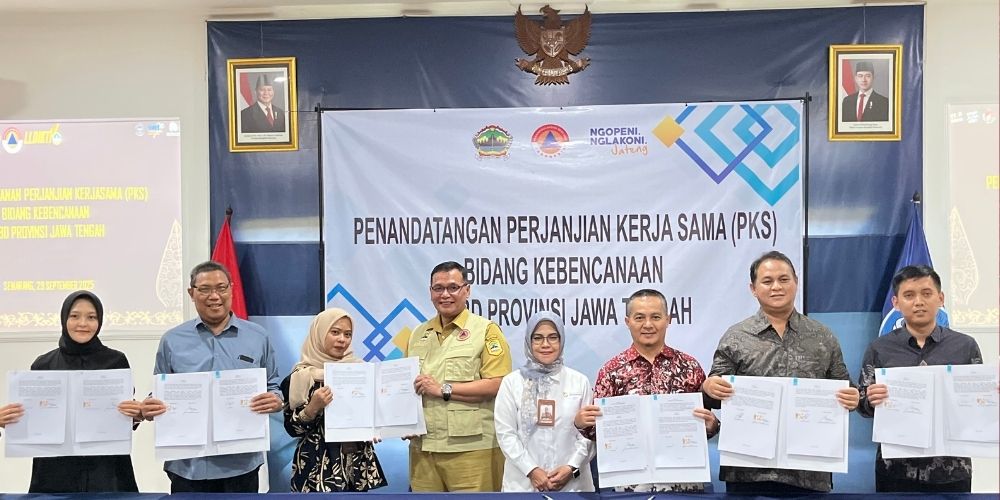

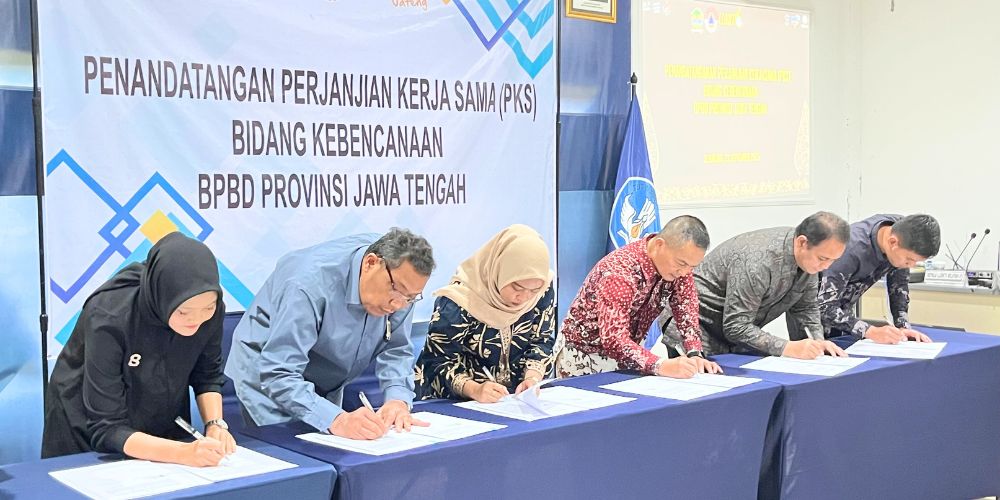
Semarang, September 29, 2025 – Universitas Muhammadiyah Surakarta (UMS) continues to strengthen its role as a higher education institution that provides tangible contributions to society. One of these strategic steps was realized through the signing of a Cooperation Agreement (PKS) in the field of disaster management with the Central Java Provincial Disaster Management Agency (BPBD), held at Building H, LLDIKTI Region VI Central Java Office.
UMS was represented by Nurgiyatna, S.T., M.Sc., Ph.D., Director of Reputation, Partnerships, and International Affairs (DRKUI), who signed the agreement, accompanied by Sidiq Permono Nugroho, S.E., M.M., Head of Industrial Partnership Development. The event was also attended by Bergas Catursasi Penanggungan, S.Sos., M.Si., Head of the Central Java BPBD, along with BPBD officials, the Bureau of Government, Regional Autonomy, and Cooperation of the Central Java Provincial Secretariat, as well as leaders from two state universities and 23 private universities across Central Java.
This agreement is a follow-up to the cooperation document between universities and the Governor of Central Java. Through this synergy, BPBD and universities will strengthen collaboration in disaster management, the establishment of Desa Tangguh Bencana (Disaster-Resilient Villages/DESTANA) and Kota Tangguh Bencana (Disaster-Resilient Cities/KATANA), as well as optimize the role of academia in enhancing community preparedness.
Prof. Dr. Ir. Aisyah Endah Palupi, M.Pd., Head of LLDIKTI Region VI, appreciated this initiative as a significant strategy in realizing impactful universities.
“Higher education institutions play a vital role through the Tri Dharma: education, research, and community service. This collaboration aligns with the Kampus Berdampak (Impactful Campus) policy, where universities not only produce graduates but also directly engage in solving real-world challenges, including disaster management,” she emphasized.
Prof. Aisyah also highlighted three strategic values of this collaboration:
– Strengthening human resource capacity for students and communities through disaster training;
– Supporting data-driven and science-based research to provide disaster management recommendations;
– Empowering communities to be more literate and prepared for potential disasters.
Meanwhile, Bergas Catur, Head of BPBD Central Java, noted that of more than 8,000 villages in Central Java, around 4,500 are classified as disaster-prone, but only about 2,000 have disaster management systems.
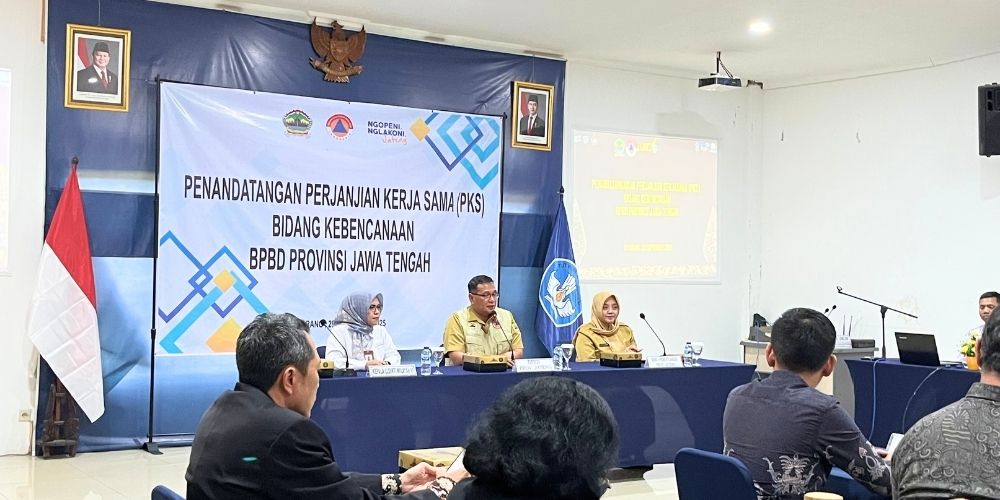
“This collaboration is a concrete step to accelerate the realization of Disaster-Resilient Villages. Academia plays a strategic role, from supporting digital mapping, disaster mitigation education, to developing appropriate technologies that can be directly implemented in villages,” he explained.
UMS affirmed that this collaboration will be followed by real implementation, including through Thematic Community Service Program (KKN) on Disaster Management, impactful internships, and research directed at addressing disaster-related challenges at the village level.
“This collaboration opens broad opportunities for many study programs at UMS to be involved according to their respective fields of expertise. With cross-disciplinary participation, we are optimistic that UMS’s contribution will make a real impact in strengthening community resilience to disasters,” said Nurgiyatna, Ph.D.
Adding to this, Sidiq Permono Nugroho, M.M., stressed that the cooperation would be followed up with concrete steps.
“The next step is to map relevant units, both study programs and research centers at UMS, so they can contribute according to their capacity and expertise. In this way, the cooperation does not stop at documents but truly results in measurable implementation,” he asserted.
As a form of consistency, UMS reaffirms its commitment to continue serving as a strategic partner for both government and communities in building Disaster-Resilient Villages. Through research, technological innovation, and community engagement, UMS is ready to provide sustainable contributions toward a more prepared, resilient, and prosperous society.