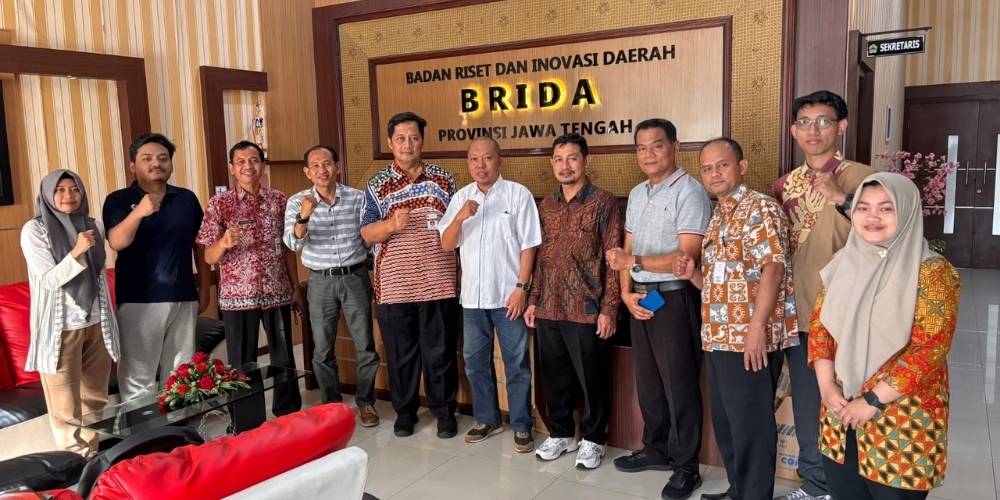

Surakarta, August 22, 2025 – The Directorate of Reputation, Partnerships, and International Affairs (DRKUI) of Universitas Muhammadiyah Surakarta (UMS) visited the Regional Research and Innovation Agency (BRIDA) of the Central Java Provincial Government on Friday (22/8/2025). The meeting marked the beginning of a strategic collaboration aimed at strengthening synergy between universities, government, and industry to promote research and innovation that generate real benefits for society.
The strategic discussion, held at BRIDA’s office, highlighted the importance of directing research beyond academic publications toward practical implementation. Both institutions agreed that research must contribute not only to scientific advancement but also to solving pressing community problems and supporting regional development.
Joko Mulyono, S.STP., M.Si., Head of Human Resources, Science and Technology, and Research and Innovation Infrastructure Division at BRIDA Central Java, emphasized the need to strengthen academic competence at universities. “The scientific capacity of lecturers and researchers at UMS must continuously improve so that the quality of research will be higher and more impactful for society,” he stated.
Drs. Mohamad Arief Irwanto, M.Si., Head of BRIDA Central Java, outlined the agency’s journey since its establishment in 2003 and integration into regional research and development in 2010. He stressed BRIDA’s role in supporting research-based planning, policy strengthening, technology development, and acting as a liaison for collaborative partners. “The number of research projects in Indonesia continues to grow, but their implementation still requires proper models and approaches to ensure they bring real impact,” he explained.
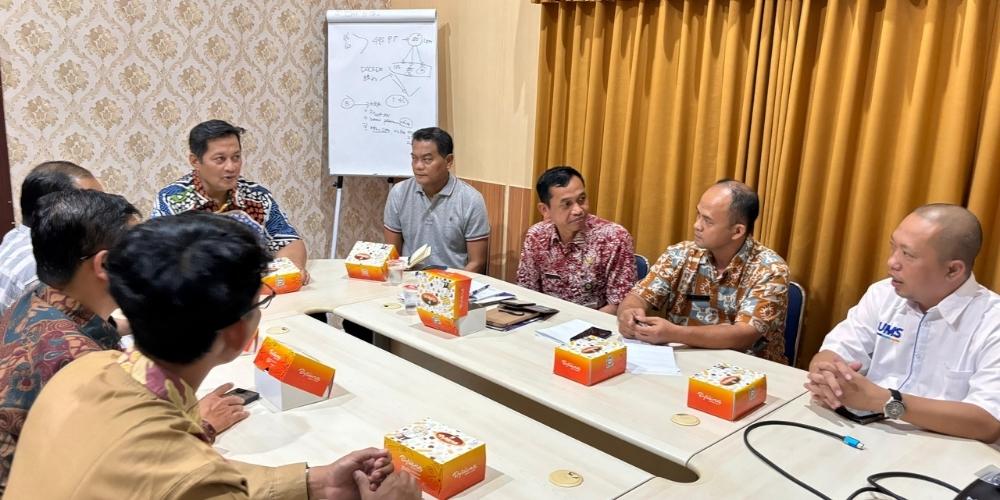
Representing UMS, Sidiq Permono Nugroho, M.M., Head of the Subdirectorate of Reputation, Partnerships, and International Affairs, noted that the collaboration aligns with UMS’s Key Performance Indicator (KPI) 6, which emphasizes community engagement. “This collaboration with BRIDA provides an opportunity to accelerate research downstreaming, expand networks with industry, and deliver broader benefits for both academics and society,” he said.
UMS Professor Prof. Dr. Anton Agus Setyawan, S.E., M.Si., added that the government is currently encouraging research with tangible impacts. He underlined that while UMS has strong research potential, expanding networks with government and industry is essential. “Universities often stop at publications in international journals, while the real challenge is bringing research results to society. Collaboration with BRIDA Central Java and Solo Technopark is highly strategic in linking academic research with field implementation,” he remarked.
Prof. Anton further highlighted the importance of research downstreaming. According to him, industries already have products but often face challenges in marketing and regulatory aspects, while universities produce research findings that remain at the academic level. “The government is now facilitating a matching process between universities and industry. However, resources, methods, and research directions within universities must continuously adapt to remain relevant to societal needs,” he added.
Miftah, a representative from BRIDA Central Java, also pointed out that many research projects remain at the academic stage despite urgent real-world problems requiring solutions. He stressed the need for policy bridges to ensure that regional flagship research can be implemented collaboratively with government and industry.
The meeting concluded with a joint commitment between UMS and BRIDA Central Java to strengthen research and innovation collaboration. Both parties emphasized that research should not stop at academic discussion but must be directed toward real-world solutions that benefit communities, government, and industry. This synergy is expected to generate innovations that meet societal needs while supporting regional and national development goals.